
When we talk about IVF, most of the conversation stays inside the lab. Oocyte quality, sperm preparation, fertilization, embryo grading, blastocyst development, transfer technique. All of that matters enormously, and I spend most of my working life on exactly those things. But none of it finishes the story. An embryo does not implant into a dish or a drop of culture medium. It implants into living endometrium, where hormones, cytokines, immune cells, blood vessels, and signals from the embryo itself all have to line up with a precision that still amazes me.
That is why I think immunology belongs firmly inside clinical embryology. It helps explain something every embryologist has seen: a technically clean cycle that still fails, or a good-looking embryo that meets an endometrium which is quietly unreceptive without ever looking abnormal. The Elgheriany review makes this point directly, arguing that a lot of poor outcomes are made worse by indiscriminate immune therapy, mistimed testing, and a failure to tell immune-mediated problems apart from non-immune ones.
Implantation is a sequence, not a switch
Here is the idea that reframed how I think about implantation. It is not a steady state where you simply turn the immune system down. It is a sequence, and the order matters. The endometrium around implantation first needs a controlled inflammatory burst, and that early inflammation is what supports the blastocyst as it apposes and adheres. In the ERIF review, cytokines like IL-1β, IL-6, IL-8, and MCP-1 belong to this inflammatory priming phase. So if we suppress that phase too early or too broadly, we can interfere with something that was never pathological in the first place. It was physiology. Then, after that short inflammatory window, the system has to pivot fast toward tolerance and angiogenesis. When that pivot fails, you get one of the leading biological explanations offered for recurrent implantation failure and recurrent pregnancy loss.
The tolerance phase, and why single numbers mislead
The tolerance phase is where the phrase "immune tolerance" finally earns its keep. In a healthy implantation, IL-10 climbs while TNF-α drops, and ratios like TNF-α/IL-10 and IFN-γ/IL-10 can hint at whether the system is moving toward tolerance or getting stuck in inflammation. The review is careful here, and so am I. The direction of change over time tells you far more than any isolated value, and no universal thresholds have been standardized across different assay platforms. In plain terms, we have signals, but we do not yet have validated cut-offs. That is worth repeating, because plenty of clinics talk as if a single cytokine value can confirm an immune cause. The literature simply does not support that kind of certainty.
The cells everyone gets wrong
A few cell types carry a lot of this shift from defense to tolerance. Regulatory T cells sit right at the center of maternal-fetal tolerance. Uterine NK cells are central too, and they are probably the most misunderstood cells in this whole conversation. Peripheral blood NK cells and uterine NK cells are not the same thing, and treating them as interchangeable causes real confusion. The ERIF review lays it out clearly. Peripheral blood NK cells are mostly CD56-dim/CD16-positive and fairly cytotoxic, while uterine NK cells are mostly CD56-bright/CD16-negative and are busy with spiral artery remodeling, trophoblast interaction, and early placentation. That is exactly why reading a blood test and extrapolating it to the uterus can lead you astray. The review also notes that if we are worried about uNK risk, the focus should be less on total CD56 counts and more on the potentially harmful CD16-positive or CD57-positive cytotoxic subsets.
Hormones are part of the immune story
The endocrine side is part of the immune story, not separate from it. The review treats hCG as far more than a luteal hormone. It describes hCG as an endocrine-immune synchronizer that can recruit or support regulatory pathways, including Treg and B-cell effects, raise IL-10, and help suppress chemokines like CXCL10. Progesterone is just as essential, and not only for holding the endometrium together. It modulates the immune environment too. Other players like LIF, IL-33/ST2, and their signaling pathways feed into receptivity, tolerance, and vascular development. This is the real immunology I want colleagues to carry in their heads, instead of the cartoon version where pregnancy only works when immunity is "low." Early pregnancy needs both defense and tolerance. It just needs them in the right order, and in the right tissue.
Why blanket immune therapy is a problem
Once you see implantation this way, you understand why blanket, unselected immune therapy is such a problem. The ERIF review says it bluntly. Immune-directed treatments in RIF and RPL have too often been handed out without matching them to the patient's immune phenotype, the phase of implantation, or any real biological plausibility. ESHRE takes a similar line, recommending individualized recognition of RIF and arguing that future research should move away from broad empirical treatment in patients whose cause is unknown. ASRM lands in the same practical place for routine IVF. Many of these immunotherapies are either unproven or under-studied, and patients deserve to be told honestly that the benefits and risks are still uncertain.
What the guidelines actually say
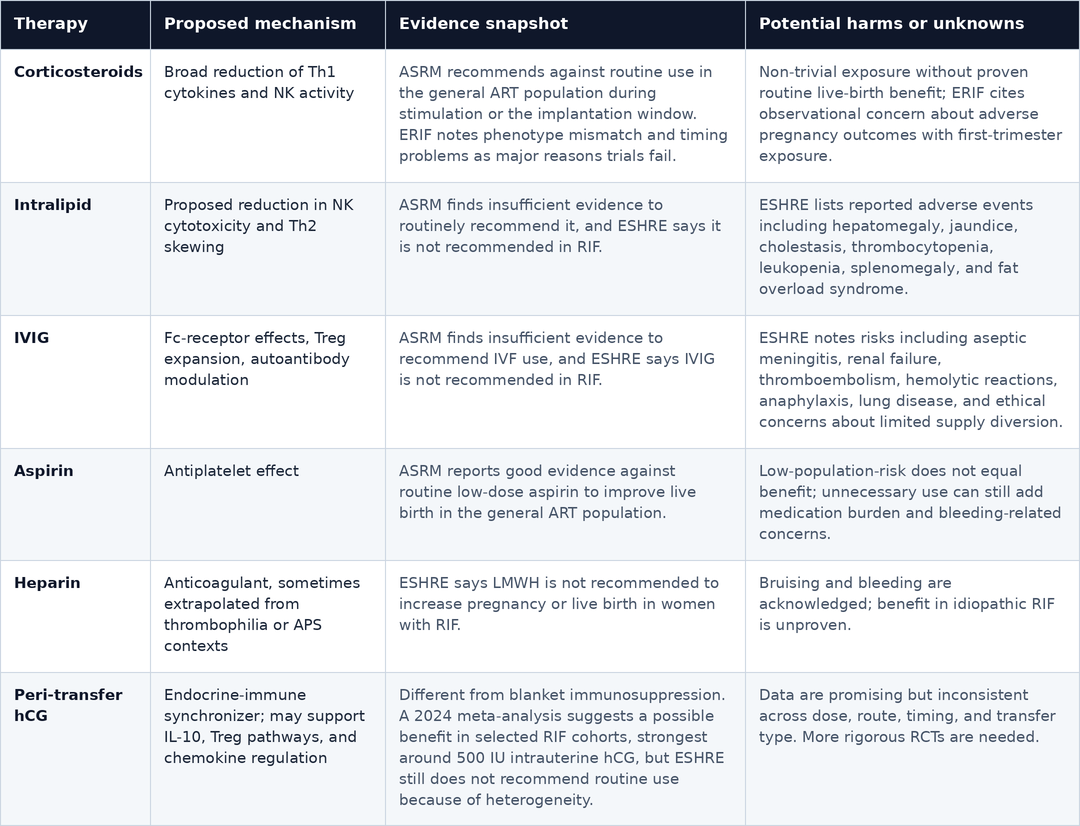
This is where it gets personal for me, because it describes exactly what I see. Steroids, intralipid, IVIG, aspirin, heparin, or full cocktails prescribed almost reflexively, sometimes just because another doctor uses them, or because the last cycle failed and something has to change. So let me put the guideline positions in one place. ASRM reports good evidence against routine low-dose aspirin for improving live birth in the general ART population, and good evidence against routine corticosteroids during stimulation or the implantation window in that same population. ESHRE concludes that intravenous intralipid infusion is not recommended, that IVIG is not recommended, that LMWH is not recommended for increasing pregnancy or live birth in women with RIF, and that intrauterine hCG injection is not recommended for routine clinical practice, because the evidence stays heterogeneous and rests largely on small studies.
This does not mean these drugs are useless
None of that means these therapies are biologically impossible or never useful. It means routine, unselected use is weakly supported. The review itself is refreshingly honest about this. Promising mechanisms often vanish once they are tested in mixed, unselected populations, and some of the success we hear about may come from referral bias or from throwing several things at a patient at once, rather than from any single reproducible effect. The authors are also clear that their own framework is a hypothesis-generating model for interpretation, not a validated treatment algorithm you can apply to everyone. That distinction matters to me. A serious field does not confuse plausible with proven.
The stewardship lesson
I keep coming back to the antibiotic analogy. The WHO is clear that misuse and overuse of antimicrobials are major drivers of antimicrobial resistance, with consequences that include treatment failure, riskier procedures, and heavy health and economic costs. Immune add-ons are not antibiotics, and I am not claiming they breed microbial resistance. But the stewardship lesson carries over cleanly. Using powerful interventions over and over without diagnosis, indication, monitoring, or a stopping rule is just poor medicine. In fertility care specifically, that can mean infusion reactions, bleeding and bruising, unnecessary cost, an emotional dependence on add-ons, and long treatment journeys that quietly pull attention away from whatever is actually causing the failures.
A better way, which starts with diagnosis
So what does better look like? To me, it is more disciplined, and in the long run far kinder to patients. It starts with diagnosis. Before anyone labels a case "immune," rule out the things that are more common and more treatable: aneuploidy, uterine pathology, chronic endometritis, a disturbed microbiome, the effects of adenomyosis or endometriosis, progesterone insufficiency, and a displaced window of implantation. If you do go ahead with immune testing, do it inside the implantation window rather than at some random point. The review suggests roughly progesterone +5 to +7 in programmed cycles and LH +7 to +9 in natural cycles. Read results longitudinally, on the same laboratory platform, and stop pretending that blood and uterine immune data are interchangeable. Most of all, what the field needs now is prospective, phenotype-stratified trials with harmonized assays and live-birth endpoints, not another round of unstratified empirical studies.
hCG, and the posture I want us to have
Peri-transfer hCG is a nice example of the right posture, because it holds two ideas at once. A recent RIF meta-analysis suggests intrauterine hCG might modestly improve implantation and clinical pregnancy in selected RIF patients, with the clearest signal in the subgroup around 500 IU, small volumes, and fairly concentrated perfusion. And yet ESHRE still does not recommend routine intrauterine hCG injection, because dose, timing, route, transfer type, and study design are all still too variable. Real biological interest sitting right next to clinical restraint. That is exactly how I think reproductive immunology should move forward. Not blanket skepticism, and not blanket treatment.
A checklist to keep by your desk
If you want the short version, here is how I approach it.
Before calling a case "immune," exclude embryo incompetence, uterine cavity pathology, chronic endometritis, dysbiosis, the impact of adenomyosis or endometriosis, luteal or progesterone inadequacy, and a suspected window-of-implantation problem.
If you are considering immune testing, sample inside the implantation window rather than randomly, roughly P+5 to P+7 in programmed cycles and LH+7 to LH+9 in natural cycles, and interpret results longitudinally on the same laboratory system.
Treat the more elaborate tests as research tools for selected cases. Paired peripheral and endometrial phenotyping, NK functional assessment, or longitudinal cytokine trajectories can be biologically informative, but the review frames them as a research scaffold, not a validated universal algorithm. ESHRE separately says routine blood cytokine assessment is not recommended in suspected RIF.
And avoid empirical therapy without a reason. No routine steroids, intralipid, IVIG, aspirin, heparin, or immune cocktails in unselected IVF or RIF patients unless there is a clear biological rationale, correct timing, and a plan for when to stop.
Common empirical therapies compared
The implantation immune sequence
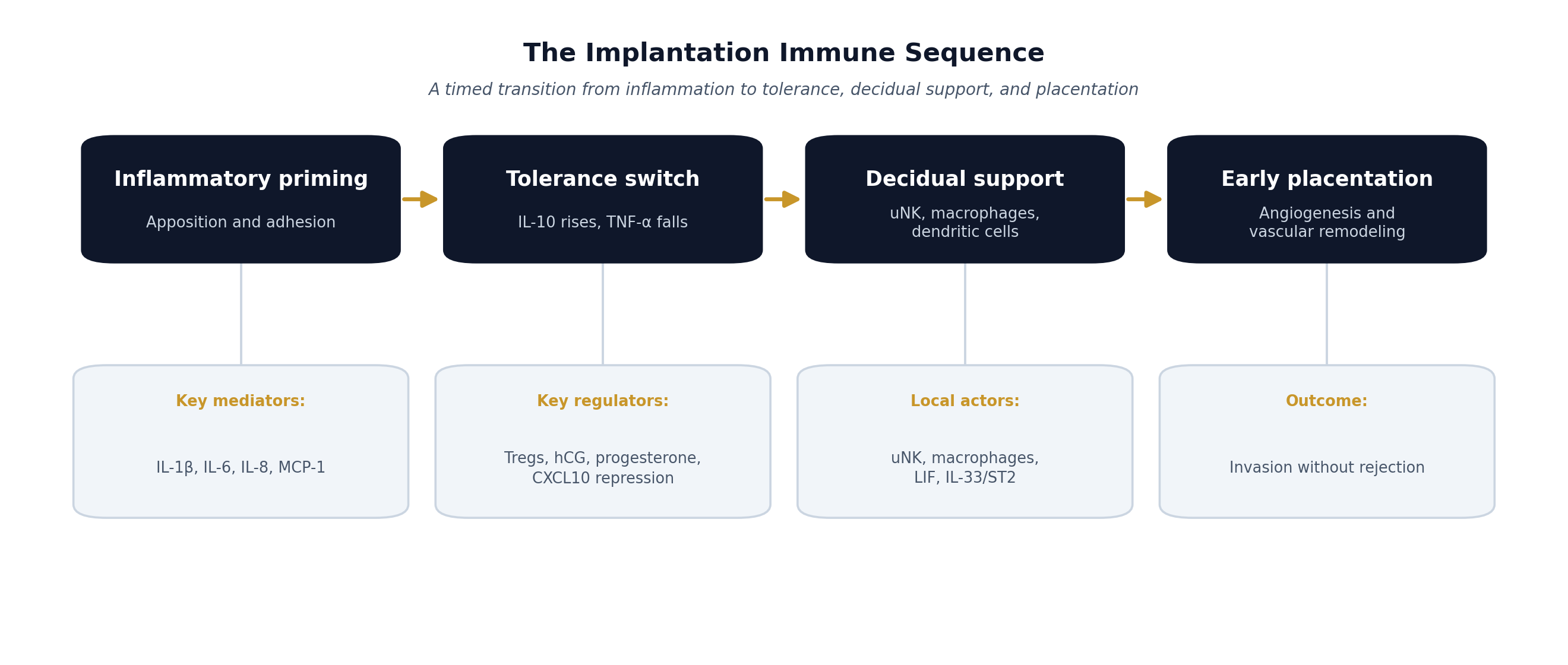
This timeline is really just the whole argument in one picture. Implantation is a sequence rather than a single tolerant state. A short inflammatory phase enables attachment, then tolerance and vascular support have to rise quickly after it. It also shows why both too little activation and stubborn, persistent over-activation can be harmful, and why the exact cytokine-ratio thresholds are still left open until assays are harmonized and externally validated
References
Elgheriany A. Phenotype- and phase-directed immune interpretation in recurrent implantation failure and pregnancy loss: an integrative framework. Front Reprod Health. 2026.
ESHRE Working Group on Recurrent Implantation Failure. ESHRE good practice recommendations on recurrent implantation failure. Hum Reprod Open. 2023;2023(3):hoad023. doi:10.1093/hropen/hoad023
Practice Committee of the American Society for Reproductive Medicine. The role of immunotherapy in in vitro fertilization: a guideline. Fertil Steril. 2018;110(3):387-400. doi:10.1016/j.fertnstert.2018.05.009
Luo X, Wu Y, Xu Y, et al. Meta-analysis of intrauterine hCG perfusion efficacy in recurrent implantation failure as defined by ESHRE guidelines. BMC Pregnancy Childbirth. 2024;24(1):468. doi:10.1186/s12884-024-06662-1
World Health Organization. Antimicrobial resistance. Fact sheet. Published November 21, 2023. Accessed July 7, 2026. https://www.who.int/news-room/fact-sheets/detail/antimicrobial-resistance
.